Author: Ida Ayu Putu Surayin, 2002. 100pgs. (Indonesian), Softcover Seri III Upakara Yajna
Publisher: Paramita, Surabaya
The third booklet in this series presents a meticulous exploration of the twenty-six banten—ritual offerings integral to the preparation of a Yajna ceremony. The author demonstrates commendable clarity in both textual description and visual representation, ensuring that readers not only grasp the symbolic significance of each offering but also understand its precise composition and arrangement. The inclusion of detailed illustrations enhances the pedagogical value of the work, serving as practical guides for practitioners and scholars alike. One of the booklet’s notable strengths lies in its emphasis on the ingredients required for each offering. By foregrounding the material components, the author underscores the profound relationship between ritual practice and symbolic meaning. This approach situates the text as more than a manual; it becomes a cultural document that preserves and transmits the intricate traditions of ceremonial worship. The booklet is particularly relevant for individuals seeking to specialize in banten paraphernalia, whether for commercial purposes or for organizing ceremonial events dedicated to divine veneration. Its dual function—as both instructional guide and cultural resource—renders it valuable not only to artisans and practitioners but also to researchers interested in the study of ritual traditions and material culture. In conclusion, this booklet succeeds in bridging practical instruction with cultural preservation. It offers readers a comprehensive understanding of the ritual offerings central to the Yajna ceremony, while simultaneously affirming the enduring significance of these practices within the broader framework of religious devotion.
Author: Wolfram Eberhard, 1990. 328pgs. (English). Photocopied Version
Publisher: Federal Publications, Singapore
This volume constitutes an indispensable reference for decoding the visual semiotics of traditional Chinese culture. First published in German in 1983 by the sociologist Wolfram Eberhard and subsequently translated into English by Routledge, the text remains a foundational resource for art collectors, historians, and students seeking to apprehend the deep-rooted meanings embedded in Chinese artistic conventions, folklore, and quotidian belief systems. The book catalogues more than 400 significant Chinese symbols, arranged alphabetically. Its scope encompasses botanical and zoological motifs, deities, chromatic symbolism, numerology, astrology, medical folklore, corporeal gestures, and elemental forces of nature. Each entry provides English equivalents, Pinyin transliterations, Chinese characters, concise illustrations, and cross-referenced essays, thereby facilitating both linguistic and cultural accessibility. Eberhard demonstrates that the majority of Chinese symbols are intimately linked to three fundamental human aspirations: longevity and health, attainment of civic or social prestige, and perpetuation of the family lineage. His analysis distinguishes several modes of symbolic function: Formal Symbols: Direct representations derived from empirical observation of nature, such as the eagle signifying physical strength and endurance into advanced age. Phonetic/Aural Symbols (rebuses): A uniquely Chinese practice of visual wordplay, wherein an object is selected because its name phonetically approximates an abstract concept. For instance, the word for bat (fu) is homophonous with the word for good fortune (fu), rendering the bat a widespread emblem of prosperity. Qualitative Symbols: Objects that symbolize abstract qualities based on their material properties, such as jade, whose purity, coolness, and smoothness confer associations with moral integrity and elevated status. Written from the perspective of a scholar deeply conversant with Chinese literature and social structures, Eberhard’s entries are firmly anchored in authentic historical context rather than superficial description. The dictionary effectively bridges diverse media, elucidating how a single symbol may recur in classical poetry, porcelain decoration, or matrimonial ritual. The entries are concise, eschewing excessive academic jargon while still conveying “insider” knowledge of esoteric folk traditions. One limitation lies in the absence of tonal diacritics in the Pinyin transliterations, which may impede language learners attempting to master accurate pronunciation. Additionally, the visual presentation reflects its original 1980s publication context: sparse black-and-white line drawings rather than high-resolution, full-color reproductions. While this minimalist format preserves clarity, readers seeking richly illustrated exemplars of art objects may find the layout somewhat dated.
Author: Christiaan Hooykaas, 1980. 209pgs. (English) Photocopied version
Publisher: E.J. Bril, Leiden, the Netherlands
Drawings of Balinese Sorcery constitutes an incisive and specialized scholarly monograph that probes the visual and esoteric traditions of Bali. At its core, the volume investigates the corpus of traditional magical drawings known as rajah—a distinctive iconography that fuses cosmological symbolism with ritual efficacy. First published in 1980 within the Iconography of Religions supplement series, the work functions simultaneously as a rare cultural archive and as an indispensable resource for scholars of Southeast Asian mysticism, anthropology, and comparative religion. The text meticulously documents rerajahan—sacred protective or aggressive magical diagrams inscribed by Balinese ritual healers (balian) or priests. These esoteric images are rendered upon diverse substrates, including paper, cloth (kajang), tree bark, metal, and clay fragments, thereby underscoring their adaptability across ritual contexts. Hooykaas dissects this complex visual cosmology into functional categories: Protection and Security — diagrams safeguarding thresholds, domestic spaces, and agricultural fields against malign forces, theft, or infestation. Healing and Wellness — ritual inscriptions applied to natural substances such as betel leaves or turmeric roots to neutralize toxins and illness. Supernatural Powers — highly restricted diagrams conferring advanced sorcery, including flight, invisibility, or elemental manipulation. Esoteric Texts — profound cosmological treatises, such as the doctrine of Kanda Mpat (the four spiritual siblings accompanying each human birth), tracing their metamorphosis into deities or demonic forces. The book is lauded for its unvarnished engagement with a domain historically veiled in secrecy. Its singular achievement lies in treating these drawings not as inert aesthetic artifacts but as functional ritual instruments. Hooykaas pairs the illustrations with detailed textual exegesis, translating concealed mantras and explicating their operative instructions. For readers seeking to transcend superficial tourist narratives of Bali, the volume offers a revelatory immersion into the mechanics of indigenous magic and religious practice. As an academic monograph, the presentation may appear dense or austere to non-specialist audiences. Hooykaas adopts a rigorously philological and iconographical methodology, privileging classification and systematic analysis over narrative storytelling. While this approach may challenge casual readers, it ensures scholarly precision and fidelity to the subject matter. Ultimately, Drawings of Balinese Sorcery stands as a masterclass in religious ethnography. It succeeds in capturing and preserving ephemeral occult practices seldom disclosed to outsiders, thereby safeguarding intangible ritual heritage. The work remains a definitive recommendation for those seriously investigating the protective, esoteric, and mystical currents of Balinese Hinduism.
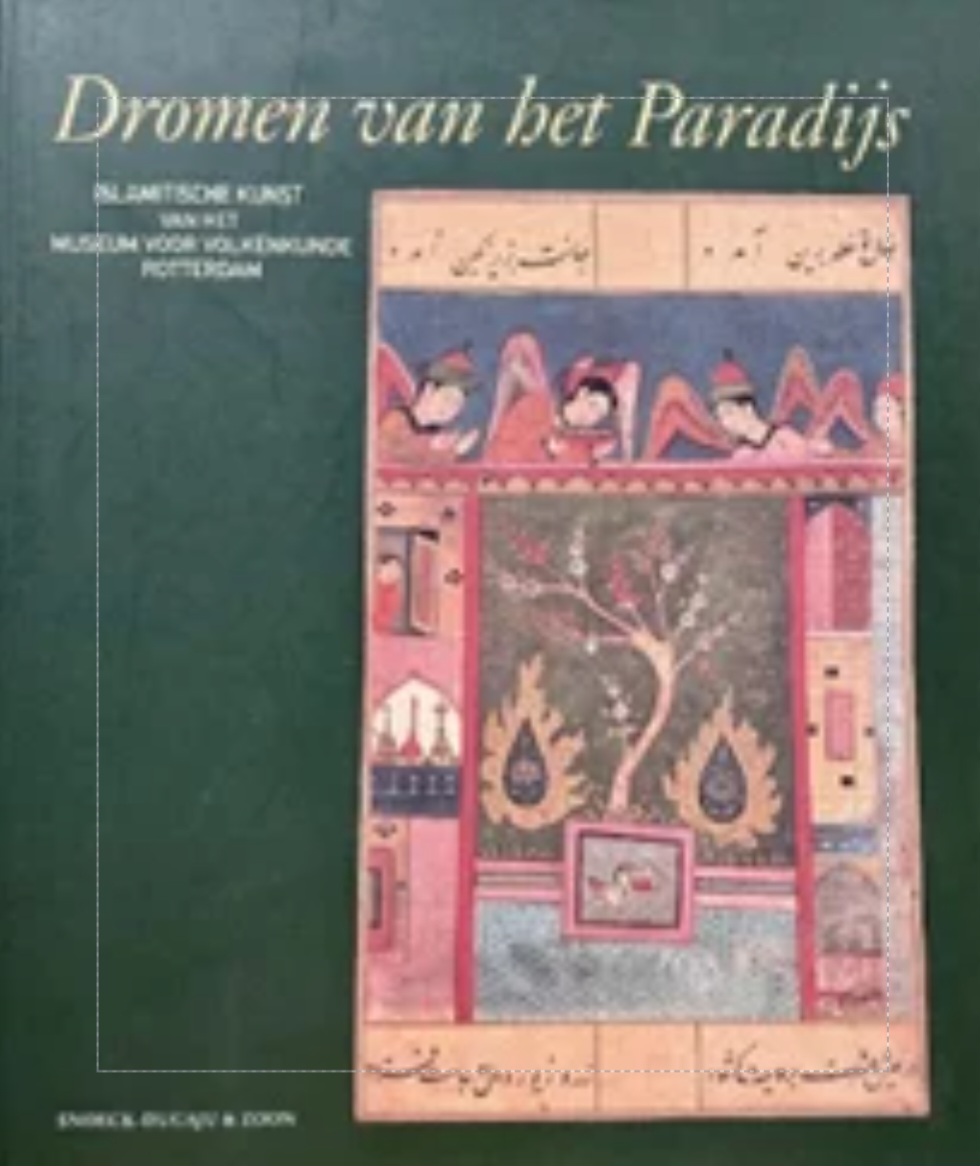
Author: Many Contributors, 1993, 221pg. (Dutch language). Softcover
Publisher: Snoeck Ducaju, Ghent, Belgium
The volume was published in conjunction with the exhibition of the same title, held at the Rotterdam Museum of Ethnology from 18 December 1993 to 7 January 1996. The book comprises a diverse collection of contributions authored by distinguished scholars. Its contents explore a wide spectrum of subjects pertaining to the Islamic and Arabic cultural spheres. Among the topics addressed are the historical development of the Arab world, the artistry of calligraphic script, the description of an intricately decorated star-tile, the traditions of Islamic mysticism, an Ottoman genealogical scroll, Turkish religious miniatures, exemplars of Mughal art, visionary depictions of the future, Persian textile craftsmanship, ritual objects such as a bowl associated with magical practices, Zar amulets, bridal attire and adornments, Iranian lacquerware, and the historical dynamics of the opium trade.

Author: E.A.Natanegara & Judi Knight Achjadi, 2012. 212pg. (Indonesian)
Publisher: Red & White Publishing, Jakarta
The book presents the Batik collection of Mrs. Yultin G. Kartasasmita, one of the past presidents of the Yayasan Batik Indonesia (YBI) or Indonesian Batik Foundation. The author provides an overview of Indonesia's decorative arts from prehistoric times to the emergence of batik. Subsequent chapters cover Mataraman batik, Coastal and Rural Batik, and contemporary regional batik.
Page 39 of 151