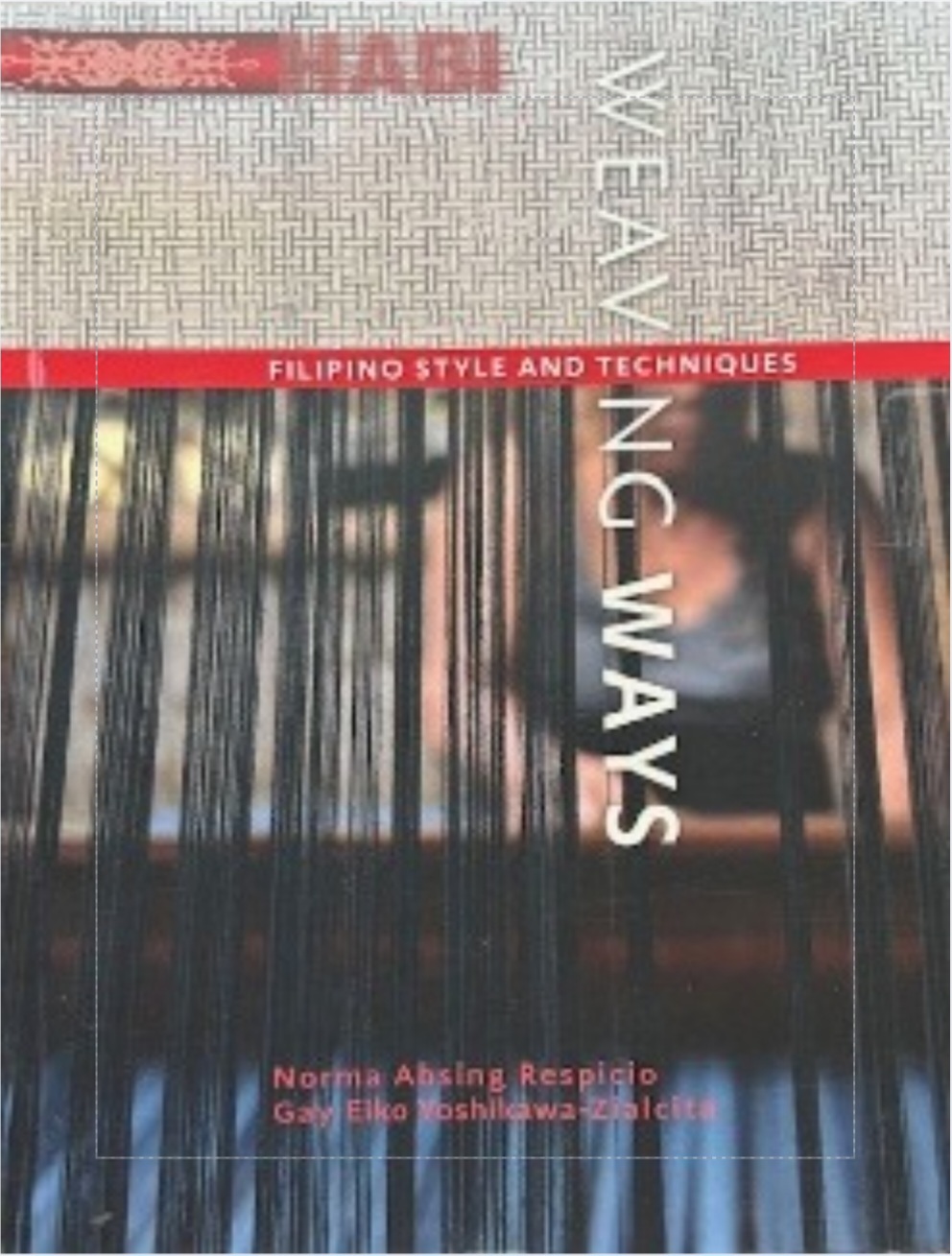
Author: Norma Absing Respicio & Gay Eiko Yoshikawa Zialcita, 2020. 271pgs. (English). Spftcover.
Publisher: HABI, The Philipine Textile Council
The initial section of this volume delineates the fundamental dimensions of weaving practice, beginning with a detailed exposition of the structural anatomy of the floor loom and the ancillary implements indispensable to the craft. It proceeds to outline the preparatory procedures required for loom installation and the technical repertoire through which artisans generate a multiplicity of woven designs. This segment functions as a methodological primer, situating weaving not merely as a mechanical process but as a disciplined engagement with material culture. The subsequent section extends beyond technical instruction to foreground the distinctive textile traditions and weaving modalities of selected ethnolinguistic communities across the Philippine archipelago—from the highland societies of northern Luzon to the diverse cultural landscapes of Mindanao. While not intended as a comprehensive survey, this portion of the text endeavors to illuminate the remarkable heterogeneity of Philippine weaving practices. It seeks to open a discursive space wherein textiles are apprehended not only as aesthetic artifacts but as cultural texts, encoding histories of community, cosmology, and identity. In this regard, the book aspires to inspire its readership to engage more deeply with the woven heritage of the Philippines. Each textile constitutes a repository of collective memory and social meaning, embodying the interplay of tradition, innovation, and identity formation. By situating weaving within its ethnographic and cultural contexts, the work underscores the role of textiles as vital expressions of Philippine cultural continuity and as enduring symbols of national identity.

Author: Judi Achjadi, 1999, 152pg. (Japanese & English). Softcover.
Publisher: Fukuoka Art Museum, Japan
This catalog showcases the richly varied corpus of woven, dyed, and embroidered textiles originating from Sumatra. These works are produced by the island’s four principal ethnic communities—Aceh, Melayu, Batak, and Minangkabau—who inhabit its eight constituent states. The textiles embody profound symbolic resonance, serving not only as garments but also as ceremonial hangings. Their functions are deeply embedded within systems of religious belief, cosmological interpretation, customary practice, and aesthetic sensibility, all of which have been transmitted across generations.

Author: Alit Veldhuisen – Djajasoebrata, 1988, 63 pgs, (English)
Publisher: Museum voor Volkenkunde, Rotterdam & The Textile Museum Toronto
Alit Veldhuisen’s volume represents her inaugural publication devoted to the study of Javanese batiks. In this work, the author concentrates on the diverse techniques of ornamentation and explores a wide spectrum of cultural and symbolic dimensions. The book examines the West Javanese myth of weaving, textiles imbued with magical potency, and the distinctive regional variations that characterize batik traditions. It further addresses the artistry of Cirebon batik, venerable floral motifs, and the symbolic resonance of the royal domains as bulwarks of tradition. Veldhuisen also investigates universal and proscribed patterns, the kain kembangan, and the imagery of the forest and the mountain. Additional chapters consider the compass card as an instrument of orientation, the representation of milestones in human life, and the emergence of new floral motifs grafted onto established traditions—aptly described as “new flowers on an old plant.”

Author: Rita Wassing-Visser, 1980, 92pp. (Dutch). Softcover
Publisher: Volkenkundig Museum Nusantara, Delft, Netherlands
Most of the pieces on display coming from the collection of the Ethnologic Museum Nusantara, date from the years 1850 to 1950. Although ancient, these textiles are still in high demand and are still considered as ancestral heirlooms. The objective of this book is to document the collection in the hope that the younger generation in Indonesia and beyond will be inspired bij these beautiful heirlooms.

Author: Unknown, Magazine number 8 “Weerzien met Indie”. (in Dutch), magazine
Publisher: Waanders Uitgevers, Amsterdam
This edition of Revisiting the Indies, a publication originally associated with the former Tropenmuseum in Amsterdam, highlights the intricate traditions of clothing and jewelry from the Netherlands East Indies. The magazine presents a vivid and richly illustrated exploration of cultural heritage, offering readers a nuanced perspective on the material culture of the archipelago. Beyond its aesthetic appeal, the issue situates these artifacts within the broader historical context of Dutch colonialism, inviting reflection on the complex legacies of empire, identity, and cultural exchange. By weaving together visual documentation and scholarly commentary, the magazine serves as both an informative resource and a critical lens through which to reconsider the colonial past of the Netherlands in Southeast Asia.
Page 149 of 151