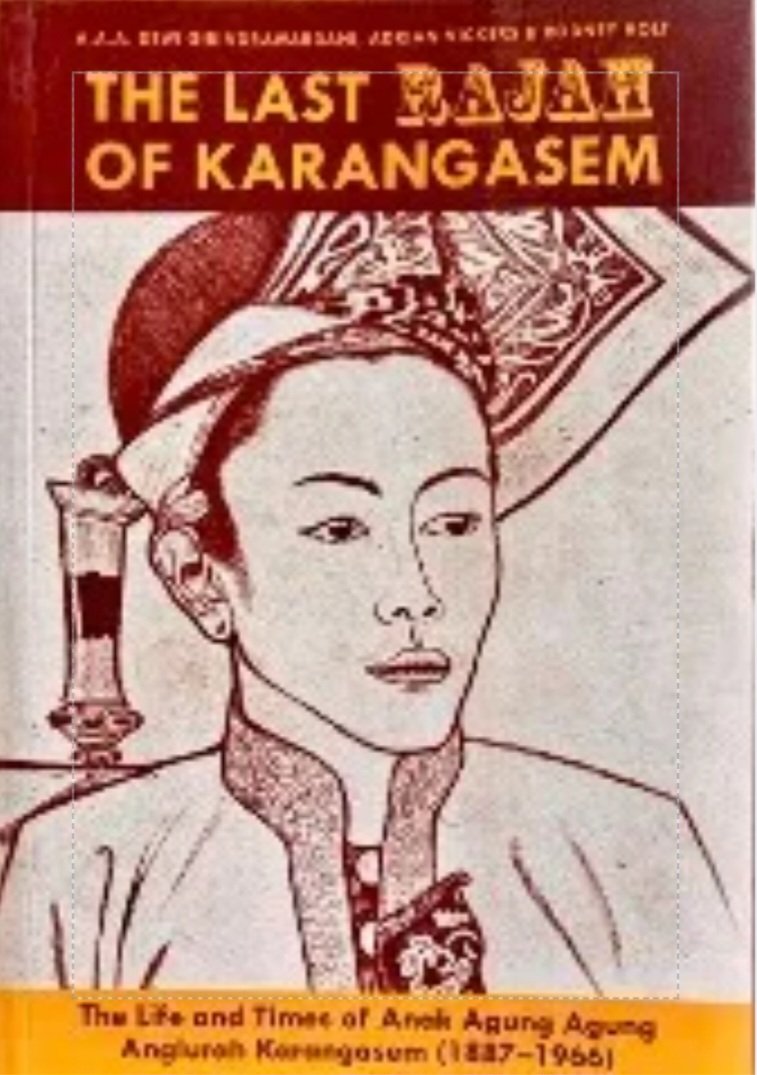
Author: A,A, Dewi Girindrawardani, Adrian Vickers and Rodney Holt, 2014. 190pgs. (English), softcover.
Publisher: Saritaksu Editions, Denpasar, Bali
This volume offers a compelling biographical study of I Gusti Bagus Jelantik, the last king of Karangasem in eastern Bali, whose life and legacy illuminate the complex intersections of politics, culture, and heritage in the island’s modern history. Organized into distinct chapters, the book benefits from multiple collaborative perspectives that together construct a richly layered portrait of the rajah. In the opening chapter, Adrian Vickers situates Jelantik’s reign within the broader historical relationship between Karangasem and Lombok, underscoring the intricate web of regional alliances and rivalries that shaped Balinese political life. The second and fourth chapters, authored by Anak Agung Ayu Dewi Girindrawardhani, granddaughter of the rajah, provide an intimate biographical lens. Her accounts portray Jelantik with candor—sometimes criticized as vain or politically opportunistic under colonial rule, yet equally acknowledged as a visionary architect, cultural guardian, and autodidact creator. His enduring contributions include the design of Tirta Gangga, the celebrated summer palace in East Bali, which stands not merely as an architectural achievement but as a symbolic articulation of Balinese cosmology, water symbolism, and royal patronage of the arts. The third chapter, contributed by Rodney Hold, founder of the Karangasem Historical Society, offers a richly anecdotal review of Jelantik’s final twenty‑five years, complemented by rare archival photography. These visual materials do more than document—they serve as cultural artefacts, preserving the memory of a royal figure negotiating the profound transformations of the twentieth century. Crucially, the book succeeds by eschewing hagiography. Instead, it presents a balanced and multifaceted portrait of a monarch navigating the turbulent waters of Dutch colonialism, Japanese occupation, and the emergence of the Indonesian republic. In doing so, it foregrounds the role of kingship as both political institution and cultural stewardship. Jelantik emerges as a figure emblematic of the twilight of Bali’s royal courts, embodying the tensions between tradition and modernity, ritual authority and colonial subjugation. Richly illustrated with archival materials, the volume is not only a biography but also a cultural heritage document. It preserves the memory of a fading era of island kingdoms while highlighting the enduring significance of royal patronage in safeguarding Balinese architecture, ritual practice, and artistic expression. As such, it is an indispensable resource for readers invested in Balinese history, local politics, and the broader discourse on cultural heritage preservation in Southeast Asia.

Author: Loro Piano, 2011. 145pg. (English)
Publisher: SKIRA, Italy
The book features full-page images depicting the life cycle of the lotus flower, cultivated by the people of Lake Inle in Myanmar. The locals wait patiently until after the rainy season when the water level rises, allowing the lotus stems to grow even longer. From these stems, they create fibres that are used to produce their sacred shawls.

Author: Judi Achjadi & Benny Gratha, 2015 (Indonesian & English)
Publisher: Musium Tekstil Jakarta
The catalog delivers a comprehensive overview of Timor's regions and showcases the strikingly vibrant colors of its textiles, which are derived from natural dyes. The author effectively details various weaving techniques, including Buna, supplementary weft, tapestry, and floating techniques, along with diverse decoration methods. The collection prominently features works from private collectors and the Jakarta Textile Museum, though the descriptions provided in this section could be more detailed.

Author: Team of Museum Curators. 2017. 284pg. (English)
Publisher: Musium Nasional Indonesia, Jakarta
This book decisively captures Indonesia's maritime history and underscores the critical importance of its trading activities. It examines the societies and cultures that emerged over time, their expansive trade networks, and the enduring legacies of powerful maritime kingdoms. Drawing on factual evidence, data, and oral histories from traders and sailors, this work illustrates the depth of this heritage. Moreover, it pays tribute to the ancestors who established vital connections for the Indonesian peoples with the wider world through the trade of agricultural and maritime products.

Author: Unknown, 2009.303pg. (Thai & English)
Publisher: The Supports Arts and Crafts International Centre of Thailand (SACICT), Bangkok
This second volume features 10 outstanding Thai artisans, masters in their own field, such as gold craft, silk weaving, brass basketry, Phare Wa weaving, sculpting, mudmee / ikat weaving, paper sculpting, incised-crafted silver, and mural paintings.
Page 129 of 151