
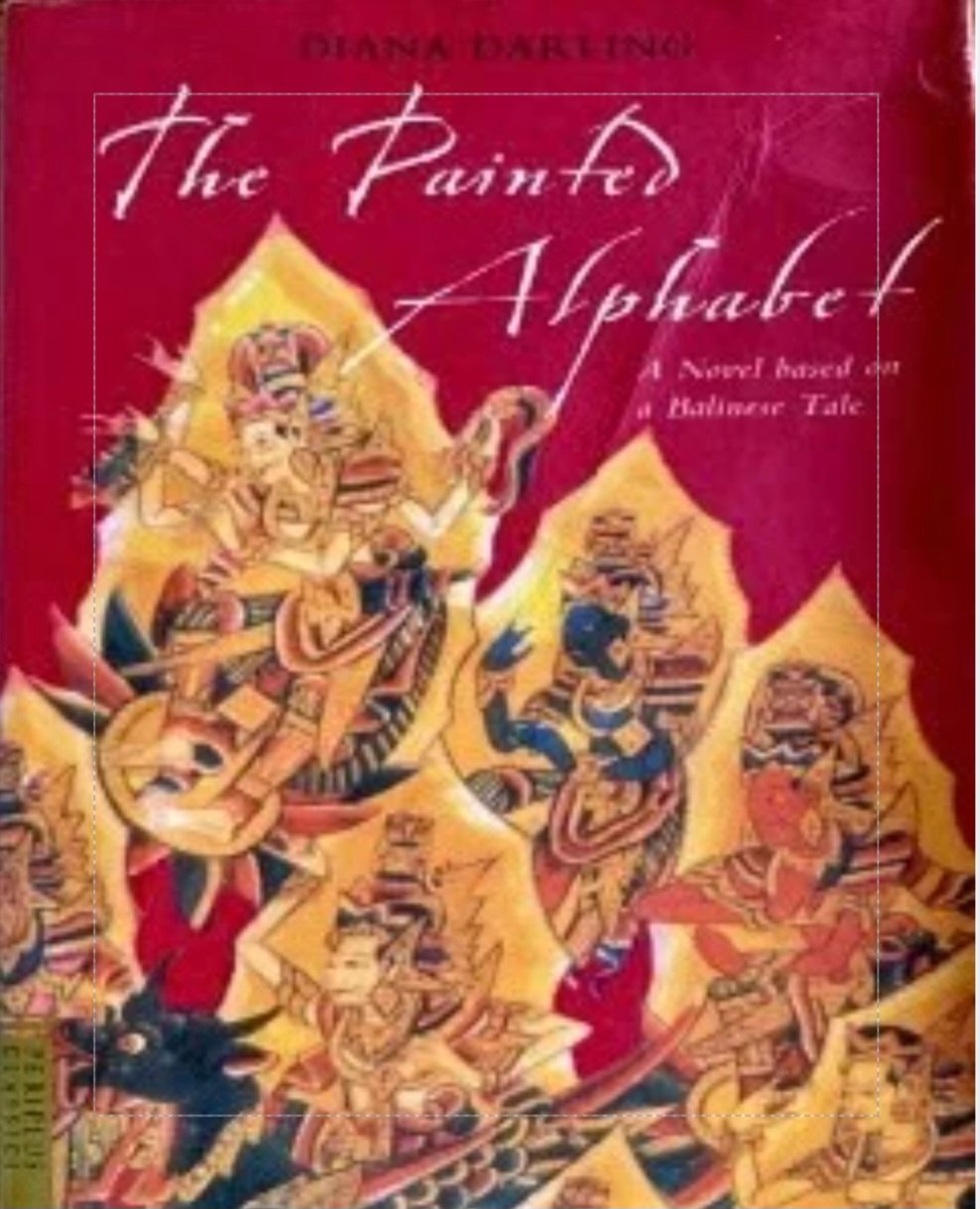
Author: Diana Darling, 2000. 209pgs. (English) Softcover
Publisher: Periplus, Singapore
This volume represents a luminous modern re‑imagining of a traditional Balinese Hindu epic, skillfully composed by Diana Darling, an American sculptor residing in Bali. By interweaving ancient mythic archetypes with the textures of contemporary Balinese life, Darling constructs a narrative that is at once timeless and vividly situated in the present. The story centers on two brothers, Siladri and Made Kerti, whose divergent choices dramatize the moral dilemmas of their era. Disillusioned by the corruption surrounding him, Siladri withdraws from his village to apprentice under a holy man in the mountains, accompanied by his wife and niece, Kusuma Sari. In contrast, Made Kerti embodies the compromises of worldly ambition. Within this framework, the author deftly juxtaposes sacred archetypes with quotidian realities, creating a world where witches, talking animals, and forest spirits coexist with tourists, buses, and cold beer. As Siladri pursues spiritual wisdom, he confronts formidable antagonists: Dayu Datu, an arch‑witch embodying destructive sorcery, and Klinyar, a monstrous creature whose presence destabilizes moral certainties. These encounters compel Siladri and Kusuma Sari to interrogate the boundaries of virtue, the ethical ambiguities of sorcery, and the fragile line between spiritual discipline and worldly temptation. Critics consistently commend Darling’s prose for its sensorial richness and poetic cadence. Her writing evokes the fragrant atmosphere of Balinese ceremonies, the tactile immediacy of weather and landscape, and the philosophical undercurrents of ritual life. The novel thus transcends mere storytelling, functioning as a meditation on perennial struggles: virtue versus wickedness, vanity versus desire, and the enduring human aspiration toward goodness. In scholarly terms, the text may be read as a cultural palimpsest, layering mythic structures upon modern social realities. It illuminates how Balinese cosmology continues to resonate within contemporary life, while simultaneously engaging universal questions of morality and human longing. Darling’s achievement lies in her ability to render the metaphysical dimensions of Balinese tradition accessible to a global readership, without sacrificing the cultural specificity and ritual depth that anchor the narrative in its indigenous context.
Author: Alfred Buhler & Eberhard Fischer, 1979. 341pgs. (English).
Publisher: Crebs AG, Basle, Switzerland
This first volume stands as a definitive scholarly contribution to the study of India’s legendary double ikat silk textiles, specifically the illustrious Patola tradition. The authors present an exhaustive and meticulously researched account that encompasses the historical trajectory, technical processes, and cultural significance of Patola weaving, rendering the work an indispensable resource for textile historians and ethnographers alike. As the first comprehensive monograph on the subject, the text delves into the extraordinary mathematical precision required for resist-dyeing both warp and weft threads prior to the loom’s preparation. This technical mastery underscores the intellectual and artisanal sophistication embedded within the Patola tradition, situating it as both a material and symbolic achievement of South Asian textile culture. The book further documents the immense historical importance of Patola, tracing its royal patronage under the Solanki dynasty and its subsequent circulation as a prized commodity in the Indian Ocean trade network. Particularly noteworthy is its role as a major export to Indonesia, where Patola textiles were not merely luxury goods but also markers of prestige, ritual value, and intercultural exchange. In this regard, the authors illuminate the broader transregional significance of Patola, positioning it within the interconnected histories of South and Southeast Asia. It is regrettable, however, that this library does not possess the companion second volume, which contains the photographic plates and motif diagrams essential for a full appreciation of the visual repertoire and iconographic depth of Patola design. The absence of this visual corpus somewhat diminishes the accessibility of the study, though the textual analysis in the first volume remains a monumental scholarly achievement.
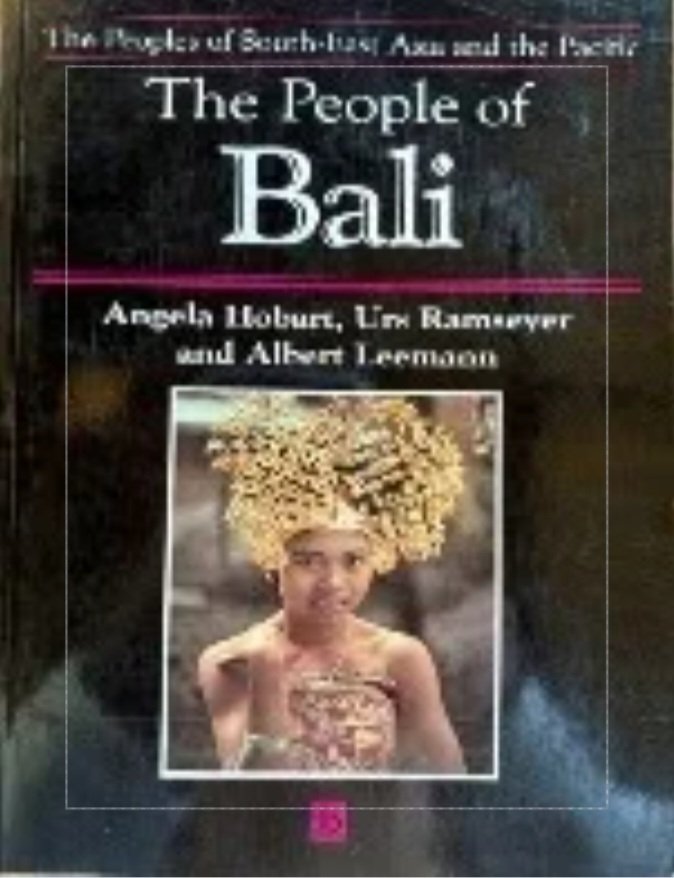
Author: Angela Hobart, Urs Ramseyer, and Albert Leemann, 2001. 274pgs. (English). Softcover The Peoples of Southeast Asia and the Pacific Series.
Publisher: Blackwell Publishers, Malden, Massachussets, USA
This volume constitutes a landmark in the scholarly interpretation of Balinese society, offering a curatorial lens that dismantles the long‑standing “exotic paradise” trope. Rather than perpetuating a static image of Bali as a cultural museum, the text foregrounds the island’s dynamic negotiation with global currents, situating ritual, art, and social order within a continuum of adaptation and resilience. The authors’ integration of geography, history, economics, and artistic practice produces a multidimensional narrative that is both analytically rigorous and accessible. Their treatment of Bali’s trajectory—from prehistoric foundations through Hindu–Javanese imperial formations to its incorporation into the Indonesian nation-state—underscores the island’s capacity to absorb external influences while maintaining a coherent cultural identity. Of particular curatorial significance are the chapters that illuminate Bali’s ritual economy, performing arts, and medical system. The documentation of mystical power and magical practices is presented with rare ethnographic objectivity, challenging reductive interpretations and inviting readers to consider the epistemological plurality embedded in Balinese lifeworlds. The book’s central argument—that a highly ritualized communal society can negotiate the pressures of individualistic, profit‑driven capitalism while sustaining collective values—resonates with broader debates on cultural continuity and transformation in the face of globalization. The inclusion of forty‑four custom photographic illustrations and three specialized maps function not merely as visual accompaniment but as curatorial evidence, grounding abstract anthropological concepts in tangible material culture. For scholars, students, and travelers seeking to move beyond the resort façade, this work provides an indispensable interpretive framework. It compels audiences to engage with Bali as a living society—dynamic, contested, and continually reconstituting its identity.

Author: Peter Carey, 2008, second edition. 970pgs. (English), Hardcover
Publisher: KITLV, Leiden, the Netherlands
The volume constitutes a monumental biography of Prince Dipanagara, leader of the Java War (1825–1830) against Dutch colonial forces. Distinguished by exhaustive research, it integrates Javanese Babad chronicles with Dutch and British archival sources. Beyond military narration, the work situates the conflict within broader social, religious, and political transformations. It probes Dipanagara’s self-fashioning as Ratu Adil (“Just King”) and the influence of Islamic mysticism. While richly detailed, with extensive appendices, its density may deter non-specialist readers. Key thematic dimensions of the Java War include: Holy war: Dipanagara proclaimed jihad against Dutch infidels and Javanese collaborators. Messianic kingship: His claim to the prophesied Ratu Adil invoked restoration of cosmic balance. Islamic identity: Rebels adopted Arabic-style turbans and robes in place of courtly attire. Court corruption: European influence, alcohol, and moral laxity at Yogyakarta provoked traditionalist ire. Colonial interference: Dutch encroachment undermined the mystical authority of Javanese sultans. Cultural disruption: Rapid European innovations imperiled sacred customs. Economic grievances: Rent, taxation, and exploitation fueled peasant discontent. The volume is a massive, masterly biography of the Javanese Prince Dipanagara, who let the bloody Java war against the Dutch from1825 to 1830. It is praised for its deep research, using both Javanese and European sources. The book is built on decades of work utilizing natuve Babad *Chronicles), Dutch and British archives. It includes an explanation of social and religious and political shifts in Java, rather than just listing battles. It explores Dipanagara’s self image as Ratu Adil (A Just King), and the role of Islamic mysticism. The book provides overwhelming detail with numerous appendices, making it too heavy for casual readers.

Author: Eric Boudot & Chris Buckley, 2015. 474pg. (English)
Publisher: Oxbow Books, Oxford, United Kingdom
This ground breaking book documents the weaving traditions and textiles of one of Asia’s most ethically diverse areas, placing them in a regional context. Based on more than a decade of first-hand study in the field, the authors record the traditions of the Miao, Yao, Buyi and other ethnic weavers from Guizhao and Hainan Island. They describe the looms and techniques of these groups including diagrams, descriptions and photographs of the weaving process and woven structures. Each tradition is illustrated with outstanding examples of textiles, drawn from the He Haiyan collection in Beijing, including many 19th century examples.
Page 131 of 151