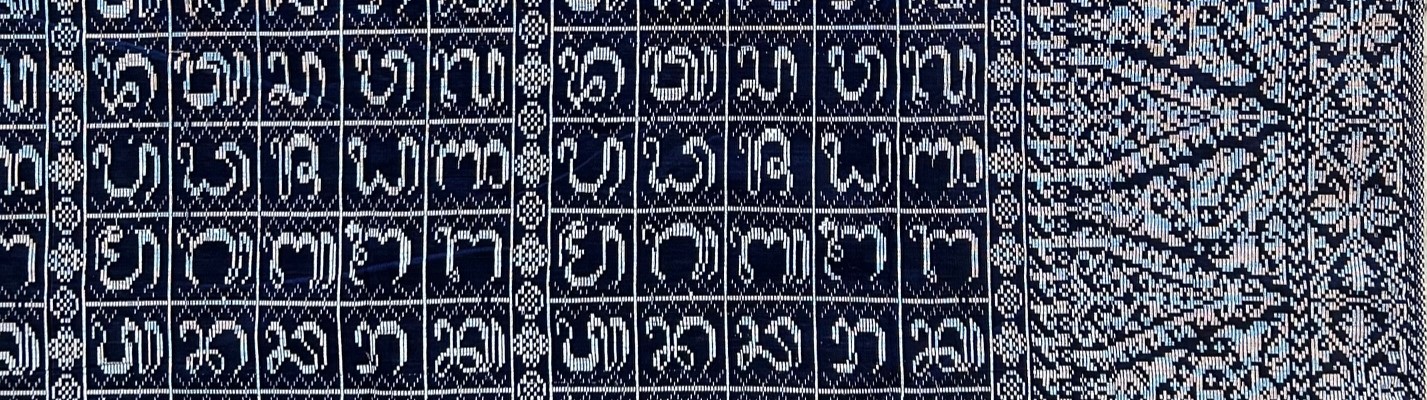

Author: Heriyanto Admojo, 2009, 211pg. (English). Hardcover
Publisher: Tiga Serangkai Solo
The volume highlights Surakarta’s distinguished Kauman district, renowned for its enduring batik tradition. Beyond this celebrated enclave, the text introduces several prominent landmarks within Solo, including the Keraton Surakarta, the city’s historic nucleus, a concise account of the Great Mosque (Masjid Agung), and the bustling Klewer Market. It further explores Kauman village, notable for its heritage mansions and the singular artistry of its handcrafted batik. Complementing the narrative, the book presents vivid color photographs that capture the cultural and architectural essence of this ancient city, alongside detailed visual documentation of Kauman’s batik craftsmanship.

Author: John Gillow, 1993. 160pg. (English). Softcover
Publisher: Thames and Hudson, London
The author commences with an exploration of Indonesia’s textile history, subsequently introducing the fundamental elements of yarn, looms, and dyes. Within the Javanese context, he highlights the intricate decorative tradition of Batik, thereby unveiling to the reader a rich universe of patterns and symbolic motifs. His discussion extends to the diverse arts of textile embellishment, including supplementary weft and warp techniques, embroidery, appliqué, beadwork, and shellwork. Furthermore, he examines bark cloth, regarded as the most ancient form of traditional fabric, situating it within the broader continuum of Indonesian textile heritage.
Author: Roger Neich & Nick Pendergrast, 1998. 160pgs. (English). Softcover
Publisher: Thames and Hudson, New York, USA
The volume under consideration represents a landmark contribution to the study of Pacific barkcloth traditions, offering a meticulously curated synthesis of historical, ethnographic, and artistic perspectives. By integrating over two hundred vivid color photographs with incisive commentary, the work transcends the boundaries of a mere visual catalog, positioning itself as an indispensable reference for scholars of Oceanic art and material culture. Authored by Roger Neich and Nick Pendergrast—curators whose decades of stewardship at the Auckland Museum have endowed them with unparalleled expertise—the text situates barkcloth (tapa) within its broader socio-cultural matrix. The authors deftly trace the trajectory of tapa from its earliest documentation during European voyages to its contemporary manifestations, thereby illuminating both continuity and transformation in Pacific textile traditions. The ethnographic rigor of the book is evident in its detailed exposition of production techniques: the harvesting of inner bark from select arboreal species, its soaking and beating into pliable cloth, and the subsequent embellishment through regional stylistic conventions. These processes are not presented as mere technicalities but as acts imbued with cultural meaning, reflecting cosmological beliefs, social hierarchies, and ritual obligations. Equally compelling is the comparative framework adopted by the authors, which highlights the nuanced variations in barkcloth usage across Melanesia, Polynesia, and Micronesia. From nuptial adornments in Tonga to sacred ritual textiles in Samoa and dance regalia in Hawai‘i, the book underscores the polyvalent functions of tapa as both quotidian garment and sacral artifact. The scholarly merit of this volume lies not only in its ethnographic depth but also in its capacity to bridge disciplinary boundaries. Art historians will appreciate its aesthetic analyses, anthropologists its cultural contextualization, and practitioners of textile crafts its technical precision. The synthesis of visual documentation and interpretive scholarship renders the book both authoritative and accessible, ensuring its relevance to academic and non-specialist audiences alike. In sum, this publication is more than a guide; it is a definitive compendium that enriches our understanding of Pacific barkcloth as a dynamic medium of artistic expression and cultural identity. Its clarity, comprehensiveness, and visual splendor secure its place as a cornerstone in the literature on Oceanic material culture.

Author: Mark Ivan Jacobson & Ruth Mary Yeager, 1995 & 2002. 178 pgs. / 324pgs. (English). Softcover.
Publisher: Batuan Biru Productions, 1995, Jacksonville, Illinois, USA Studies & in the Material Cultures of Southeast Asia Series no.2. Photocopied version. & White Lotus 2002 – Bangkok, Thailand
This book (1995) is one of the first reports in English on traditional textiles mainly men’s selimuts from West Timor (Amarasi, Amfoang, Amanatun, Amanuban, Molo, Biboki, Insana, Miomafo, Malaka & Belu (Tassifeto), Lamaknen/Belu, and Ambenu (East Timor). The reports were written as a part time job alongside the primary job of Mr. Jacobson in Timor in 1995 as a geophysicist exploring hydrocarbon mining. Besides the physical and cultural setting, history, the role and art of weaving, regional descriptions of selimuts and sarongs, the authors present many photos and hand-drawn motifs to clarify their writings. A good initiative to document initial research on the textile art of West Timor, which was latter upgraded to the 2002 book published under the same name by White Lotus in Bangkok.
Author: Luh Ketut Suryani & Gordon J. Jensen, 1993. 264pgs. (English). Softcover
Publisher: Penerbit ITB, Bandung
This volume constitutes a cross-cultural inquiry into the intersections between Balinese ritual trance and Western psychiatric constructs of dissociative identity and self-harming behaviors. Luh Ketut Suryani, a Balinese psychiatrist, together with Gordon D. Jensen, an American psychiatrist, contend that both quotidian and ritualized Balinese trance-possession phenomena share underlying psychological frameworks with what Western psychiatry formerly classified as Multiple Personality Disorder (MPD), now recognized as Dissociative Identity Disorder (DID). The text situates its analysis within Balinese social structures, examining traditional healing practices, gamelan performances, dance-drama, and manifestations of severe mental illness. It argues that cultural norms and ritual frameworks shape ego states, permitting controlled dissociation during religious festivals without pathological consequence. In juxtaposition, the authors compare socially sanctioned Balinese possession with the concealed distress of Western DID, thereby illuminating divergent cultural interpretations of dissociative states. Further chapters address the impact of modern societal transformations and fractured coping mechanisms on suicide and acute psychological distress in Bali. The strength of the work lies in its rare insider–outsider collaboration, blending deep local ethnographic insight with clinical psychiatric analysis. Yet, some anthropologists caution that equating sacred ritual trance directly with Western psychiatric pathology risks oversimplifying the complex spiritual and symbolic dimensions of possession. Ultimately, the book emerges as essential reading for scholars of cross-cultural psychology, mental health, and the contested boundary between spiritual practice and psychiatric illness.
Page 139 of 151