
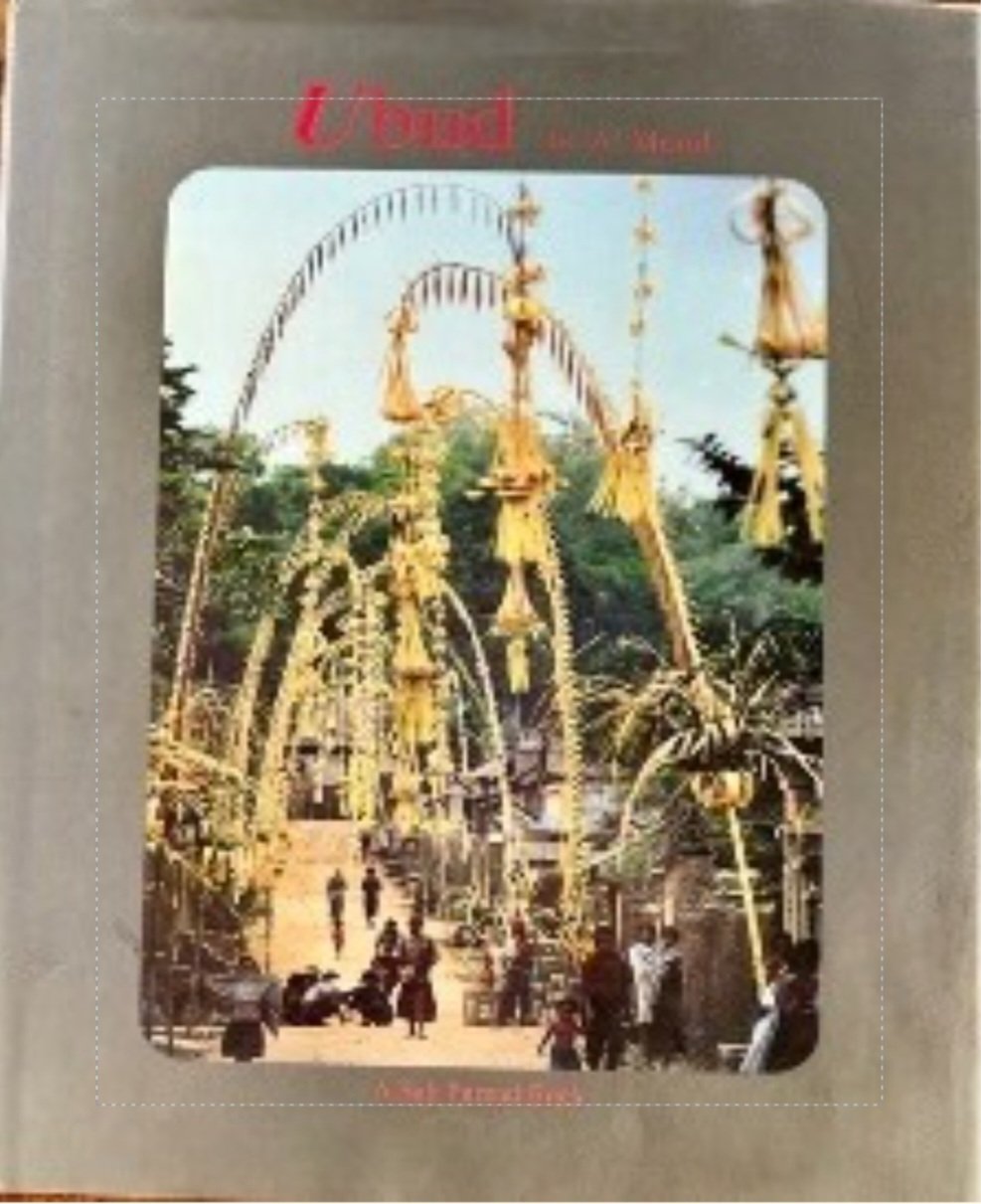
Author: various, directed and designed by Leonard Lueras, 2004. 157pgs. (English). Hardcover
Publisher: Bali Purnati Center of the Arts, Batuan, Sukawati, Gianyar, Bali
This volume constitutes an insider’s portrait of Bali’s cultural capital, Ubud. Eschewing the conventions of a standard linear travel guide, it unfolds instead as a richly eclectic mosaic of local life, artistic practice, and eccentric expatriate lore. The narrative interweaves real-life tales, gossip, and reminiscences drawn from a diverse constellation of long-term foreign residents and native “Ubudians,” thereby offering a textured ethnographic vantage on the town’s social fabric. The book opens deep windows into both contemporary and traditional Balinese arts, extending to musicological insights and even natural history—exemplified by Victor Mason’s whimsical vignettes that refract Ubud through the perspectives of various bird species. Generously styled with striking visuals and anecdotal fragments, the volume advances the notion that Ubud is as much a fluid state of mind as it is a geographical locus. Praised as an endlessly browsable treasure trove, the text rewards serendipitous reading: opening to any page yields delightful minutiae, arcane facts, and vivid historical snapshots of the region’s creative community. In its intimate, sprawling scrapbook-like form, the book functions less as a practical, structured guidebook than as a cultural artifact and atmospheric keepsake—an archival testament to a particular moment and circle within Bali’s evolving artistic milieu.
Author: Hermawan Kertajaya & Bembi Dwi Indrio, 2009. 255pgs. (Indonesian). Softcover
Publisher: Gramedia Pustaka Utama, Jakarta
Ubud, the Spirit of Bali constitutes a compelling exploration of how a seemingly modest village in central Bali has sustained its global allure and preserved its timeless spiritual essence across centuries. Far from conforming to the conventions of a travel guide, the volume operates as a distinctive hybrid between cultural anthropology and strategic marketing. It interrogates the precise mechanisms by which Ubud safeguards its profound heritage while simultaneously flourishing within the dynamics of a globalized economy. Kartajaya situates Ubud’s enduring success within three contemporary paradigms—spiritual marketing, eco‑marketing, and social marketing. He persuasively demonstrates that the town’s commercial vitality is not incidental but rather the deliberate outcome of fidelity to its foundational values. The narrative guides readers through a richly textured historical and cultural trajectory, encompassing traditional arts, intricate religious obligations, and quotidian practices of community governance. Extending across 276 pages, the text is lavishly illustrated with high‑quality photographs that vividly convey the warmth of ceremonies, the intricacy of architectural forms, and the palpable atmosphere of the locale. By juxtaposing corporate marketing frameworks with ancestral Balinese lifeways, the book elucidates why Ubud functions as both an economic hub and a spiritual magnet for long‑term travelers. It achieves an admirable equilibrium between panoramic historical analysis and finely grained accounts of village management and social cohesion. Nevertheless, certain sections reveal uneven pacing, at times privileging technical marketing discourse over the fluid narrative of Balinese communal life. Ultimately, the volume succeeds as both an educational resource and a profound source of inspiration. It strips away the glossy veneer of tourist representation to offer a blueprint for how ancient communities may engage modernity with dignity, without relinquishing their sacred legacy.

Author: Fred B. Eiseman, Jr. 1999, 265pgs. (English). Softcover.
Publisher: White Lotus, Bangkok
The book offers a comprehensive examination of ulat-ulatan, the traditional art of Balinese basketry, encompassing the full spectrum of baskets and related woven artifacts produced on the island. The techniques employed in Balinese basket-making remain consistent with those observed in contemporary practice, reflecting a continuity of cultural craftsmanship. Indeed, no Balinese household can operate effectively without possessing several varieties of these artisanal products, skillfully fashioned from indigenous materials to accommodate the demands of daily life. The author—an engineer by training and a retired instructor of Physics and Chemistry—resided in Bali for a significant period. He passed away in 2013 in Arizona, United States.

Author: Torang Sitorus, 2013. 96pg. (Indonesian)
Publisher: Musium Tekstil Jakarta
The "Ulos Pangait ni Holong" exhibition was successfully held in December 2013 at the Jakarta Textile Museum, prominently featuring Ulos, the Batak shoulder cloth, from the esteemed collection of Torang Sitorus, a dedicated fashion designer and weaving artisan committed to preserving his cultural heritage. This informative catalog unequivocally presents various types of Ulos, complete with their names and concise descriptions, serving as an essential guide to the rich world of Batak Ulos textiles.
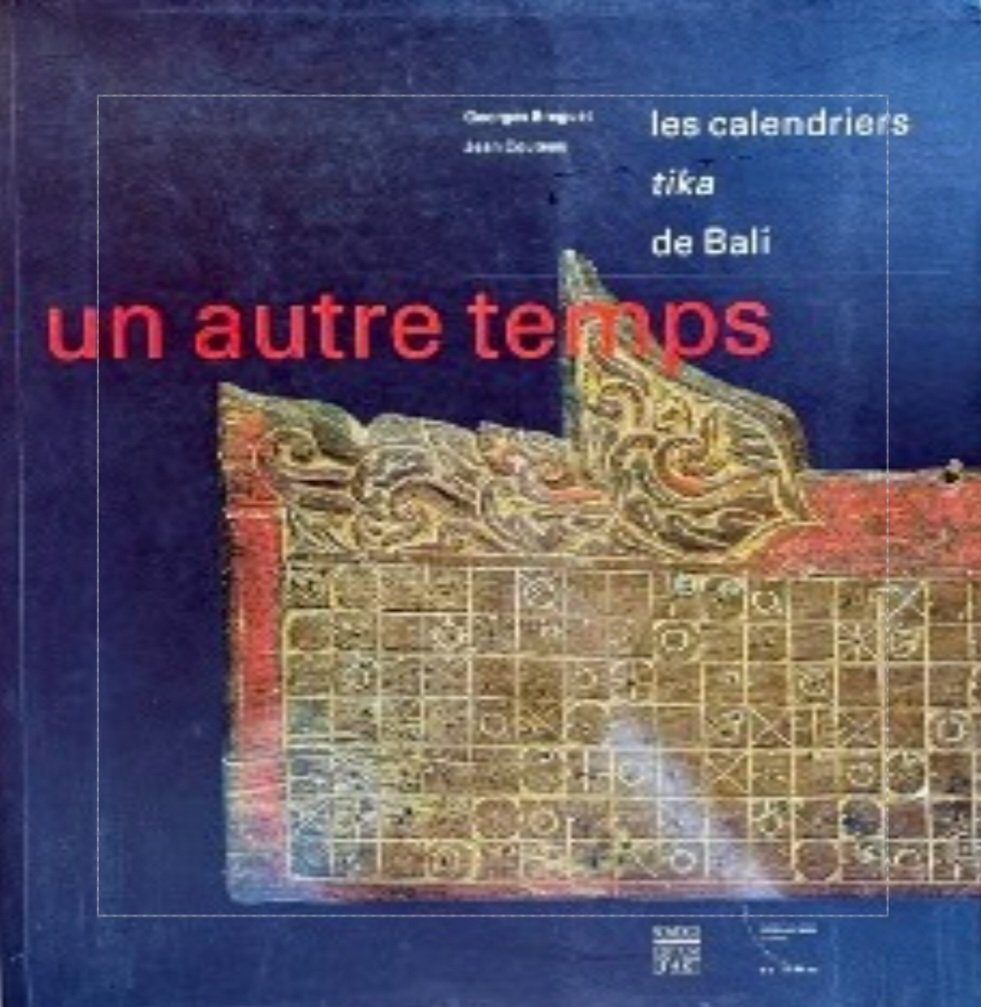
Author: George Breguet & Jean Couteau, 2002. 143pgs. (French), softcover. Catalog
Publisher: Somogy Editions d’Art, Paris
Un Autre Temps. Les Calendrier Tika de Bali emerges as a seminal contribution to the study of Balinese cultural heritage, offering a profound meditation on the tika—the divinatory calendar board that embodies the island’s cosmological imagination. Far more than a catalog, the volume situates the tika within the interwoven domains of art, ritual practice, and philosophical reflection, thereby illuminating the Balinese conception of temporality as cyclical, sacred, and ritually enacted rather than linear or secular. The text meticulously documents the painted and carved wooden calendar boards employed by priests and healers in acts of divination, revealing their dual function as both aesthetic artifacts and instruments of spiritual knowledge. The accompanying illustrations and color plates, many depicting rare museum-grade examples, provide invaluable visual testimony to the richness of this tradition, situating the objects within their ceremonial contexts and underscoring their role as mediators between human communities and cosmic order. What distinguishes this study is its capacity to reconcile chronological science with ethnographic sensitivity, rendering an intricate system of temporal reckoning comprehensible without diminishing its cultural depth. In doing so, the work affirms the tika as a living heritage—an epistemological framework through which the Balinese continue to negotiate the rhythms of ritual, agriculture, and communal life. Originally conceived as a specialized exhibition volume, the book itself has become a rare artifact, its scarcity in circulation enhancing its aura as both a scholarly resource and a cultural testament. As such, Un Autre Temps not only preserves knowledge of the tika but also exemplifies the broader imperative of safeguarding intangible heritage, ensuring that systems of meaning embedded in ritual practice remain accessible to future generations.
Page 142 of 151